
Publications
Peer-reviewed Articles
![Talking about the [same] revolution? A comparative analysis of main datasets of revolutionary events](/images/publications/korotayev2025sources.png)
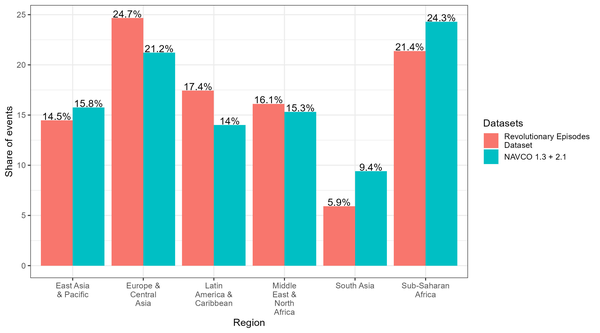
Talking about the [same] revolution? A comparative analysis of main datasets of revolutionary events
Ruslan Guseinov, Vadim Ustyuzhanin, Andrey Korotayev
Defence and Peace Economics, 2026 · journal
Abstract
We conduct a comparative analysis of the main datasets on revolutionary events, including The Nonviolent and Violent Campaigns and Outcomes (NAVCO, versions 1.3 and 2.1) Cross-National Time-Series (CNTS), Revolutionary Episodes Dataset by M. Beissinger, Revolutionary Database by the HSE University (CSRA) and Historical Regime Data (HRD). To compare these sources systematically, we develop several complementary empirical instruments designed to identify and interpret differences across datasets. We show that, although the datasets are not fully equivalent and rely on somewhat different operationalisations, definitions and coding procedures, these differences usually concern event boundaries and the inclusion of borderline cases rather than the results of cross-national quantitative analysis. Across the major sources, we recover similar temporal and spatial distributions of events and broadly the same structural predictors. We therefore argue that, while these datasets are not conceptually identical, they are empirically highly convergent for many comparative purposes.
Revolutions or Campaigns? Tearing Down the Berlin Wall in the Study of Mass Mobilization
Andrey Korotayev, Ruslan Guseinov, Vadim Ustyuzhanin
Political Studies Review, 2026 · journal
Abstract
In recent years, there has been an emergence of a sort of a “Berlin Wall” between the studies of revolutions and “maximalist campaigns”. Though the researchers of revolutions and “maximalist campaigns” tend to study quite similar phenomena, they appear to ignore each other’s work. Is this a coincidence that the study of revolutions and “maximalist campaigns” yields so similar results? Of course not, as both kinds of research pay attention to alike event types. However, the “Berlin Wall” separating them negatively affects both camps. We believe that both streams of the modern revolution research should be merged, which could set a starting point to a real breakthrough in our understanding of revolutions and pave way to the formation of the fifth generation of revolution theories.
Fiscal Capacity and Revolutionary Destabilization: A Quantitative Analysis
Ruslan Guseinov, Vadim Ustyuzhanin, Andrey Korotayev
Vestnik Permskogo universiteta. Politologiya [Bulletin of Perm University. Political Science], 2026 · journal
Abstract
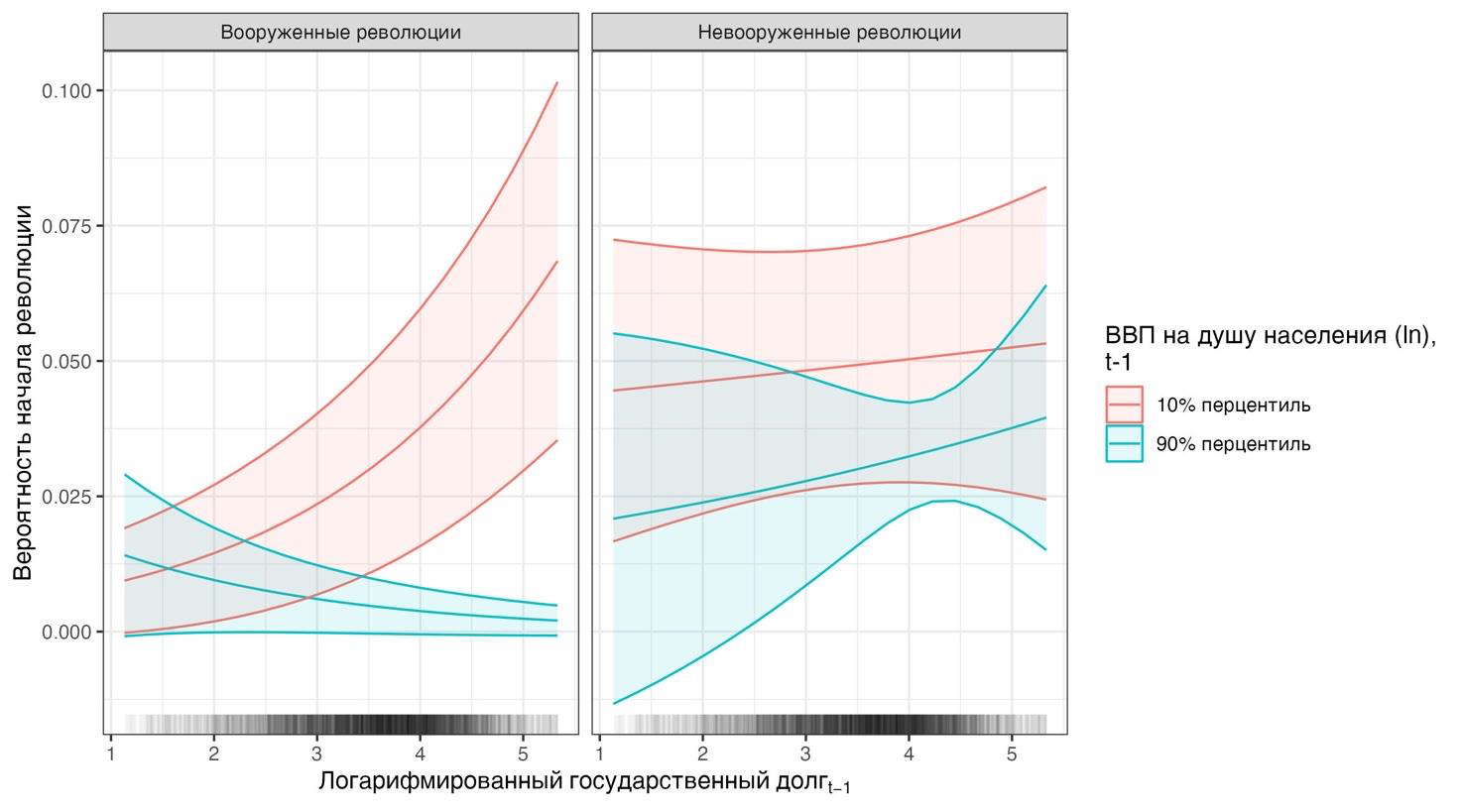
This paper investigates the relationship between fiscal stability and revolutionary onsets. Classic researchers of revolutions, such as Jack Goldstone, have provided theoretical arguments for the importance of fiscal factors, but any substantial quantitative cross-national large-n research has not been conducted yet. Logistic regression analysis with an interaction term that we have performed confirms our main hypotheses that a relationship between government debt and revolutionary onset likelihood is not uniform and depends on the levels of economic development and type of revolutionary instability. We use NAVCO 1.3 and HSE University Centre for Stability and Risk Analysis datasets as our main data sources. The results show that in developing economies, rising government debt is associated with a higher likelihood of armed revolution onset, while in developed economies, the relationship is negative. For unarmed revolutions, there are no significant differences between developing and developed economies. Such results are explained by different logics of government debt increase – developed countries increase government debt to differentiate budget policy, whilst for developing economies, increases in government debt indicate accumulated economic issues. Besides, empirical results show that an increased budget burden undermines developing countries' capacities to finance security apparatus, army, and maintain elite loyalty, provoking armed revolutions.

2024 Protests in Armenia
Ruslan Guseinov
Istoriya i sovremennost' [History and Modernity], 2025 · journal
Abstract
The article analyses quasi-revolutionary protests in Armenia in April—June 2024. The analysis outlines the main cause of the protests — the factor that is polymogenic, induced by Armenia's military defeat by Azerbaijan in 2023, which led to Azerbaijan establishing a full political and military control over Nagorno-Karabakh. The article describes the historical and political background of these protests within a particular revolutionary epoch, as well as a chronological account of the main events. Despite Pashinyan's resignation demands, this episode should be called a quasi-revolutionary one as the opposition failed to make sufficient efforts for a revolutionary siege of government.
Book Chapters
Revolutionary and Quasi-Revolutionary Episodes in the South Caucasus (2020–2021)
Ruslan Guseinov
Sistemnyj monitoring global'nykh i regional'nykh riskov [Systemic Monitoring of Global and Regional Risks], 2021 · book chapter
Abstract
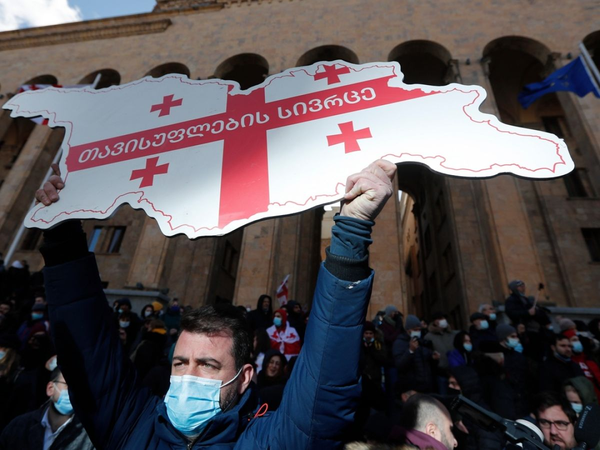
The article provides a characterisation of revolutionary events in the South Caucasus in 2020 and 2021. Revolutionary destabilisation affected two countries in the region — Armenia (2020–2021) and Georgia (2020). The analysis demonstrates that these events differ markedly in terms of duration, the intentions of the protesters, the balance of political forces, and the underlying causes that triggered instability in each country and in the region as a whole. In Armenia, for instance, opposition political forces — despite their fragmentation — explicitly pursued the goal of overthrowing the Pashinyan regime, which accounted for the prolonged and intense character of the protests. In Georgia, by contrast, the opposition did not seek to change power through unconstitutional means and advanced different demands. It is important to note, however, that both countries have maintained domestic political instability since the very proclamation of their independence. Although the protests in both countries had subsided by the time of writing, Armenia and Georgia remain the most acutely unstable states in the South Caucasus.
Manuscripts Under Review
From Dictatorship to Democracy? The Democratic Dividend of Revolutionary Mass Uprisings
Ruslan Guseinov
2026 · under review
Working Papers

contentiousR: an R package for contentious politics and civil conflict research
Ruslan Guseinov
2026 · working paper
Abstract
This article introduces contentiousR — an R package that provides various tools and datasets for contentious politics and civil conflict research. It provides a flexible workflow for creating state panels and enriching them with socioeconomic, political, and conflict indicators — using either Correlates of War (COW) or Gleditsch-Ward (GW) country coding schemes. The package bundles ten preprocessed conflict and campaign event datasets, provides a pipeline workflow to conveniently add covariates, enables harmonizing external conflict event data sources, offers diagnostic tools to visualize their regional and temporal coverage, and supports interoperability with {peacesciencer}, another prominent R package in the subfield of peace science. The package's usage is illustrated with an example modeling revolutionary onset and comparing datasets of revolutionary events. The package maintains a website on GitHub: https://rguseinov.github.io/contentiousR/
The Price of Silence: Fiscal Capacity and Mass Anti-Regime Mobilization in Autocracies
Ruslan Guseinov
2026 · working paper
Abstract
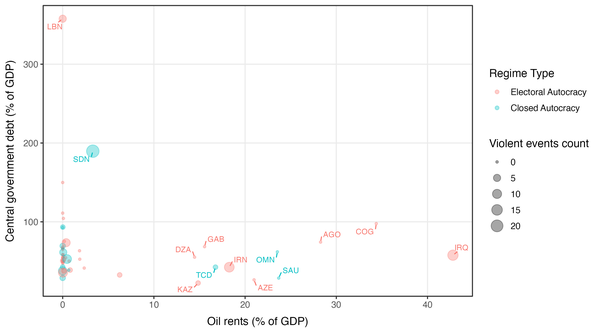
Why do some autocracies experience violent anti-regime mobilization while others remain quiescent? The literature does not provide sufficient theoretical arguments and empirical evidence linking fiscal strength in autocracies to mass mobilization. In my paper, I suggest that fiscal capacity shapes authoritarian stability: autocracies with greater fiscal room can finance public goods, the military and security apparatus at high levels, solving the fundamental problem of authoritarian control and power-sharing. Moreover, higher fiscal capacity increases protest costs for citizens, which constitutes a 'silence-buying' effect, a new term I coin in the context of authoritarian civil resistance. My argument stems from some comparative politics theories and theoretical statements of Jack Goldstone and Theda Skocpol. Using panel data on violent mass anti-regime mobilization from 2003 to 2022 and introducing a novel operationalization of fiscal capacity as central government debt, I employ logistic models for protest onset and negative binomial models for protest counts to estimate the effect of the central government debt on violent contention. Across specifications, robustness checks and zero-inflation corrections, the effect stays significantly positive, suggesting that fiscal constraints pose a destabilizing threat to autocracies. Findings show that fiscal capacity has been overlooked as a viable factor of contention and provide sufficient evidence in favor of a new operationalization of fiscal capacity.
Work in Progress
Economic Sanctions and Political Instability
Ruslan Guseinov
2026 · in progress